
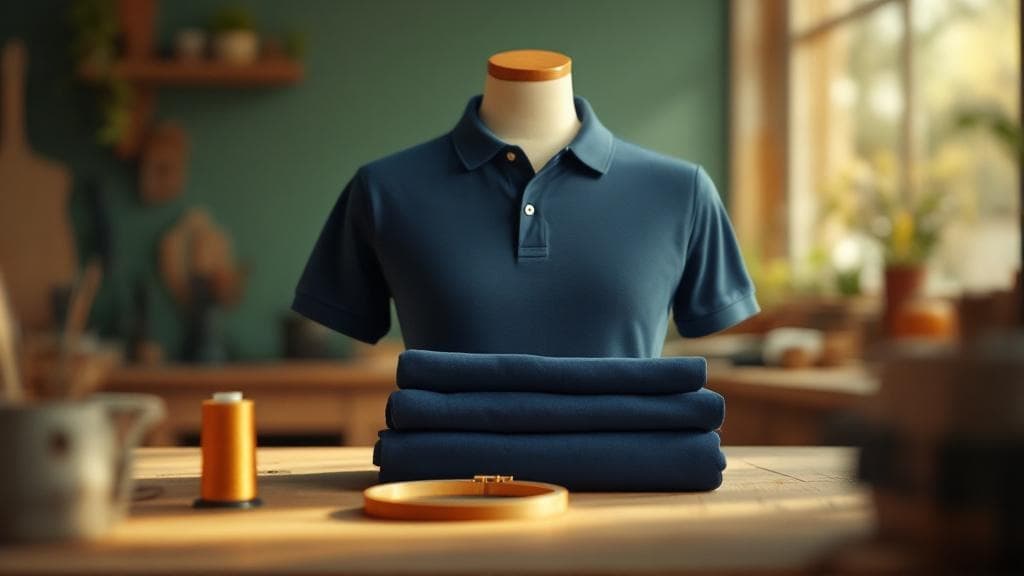
For a bank teller team, the right polo is a 6-ounce performance pique in a polyester-cotton or polyester-spandex blend, with an 8,000-stitch left-chest embroidery in Pantone-matched thread, ordered at 125 percent of your teller headcount. Avoid 100 percent cotton interlock for teller-line wear and avoid screen-printed logos on knit polos. Below is the specification I quote against for community banks across NH and northern MA.
I have embroidered staff apparel for 28 years. The complaints I hear from HR managers six months after delivery follow a pattern. The polo pilled on the cuffs and looks worn after 40 wash cycles. The cotton stretched out of shape after the staff member sweated through one summer day. The screen-printed chest logo cracked because knit fabric stretches and ink does not. All three problems are spec problems, and all three are solvable at the PO stage.
The five spec decisions, in order of consequence
- Fabric weight: 6 ounces is the sweet spot for teller-line wear. 5-ounce polos drape better and look slightly more upscale but pill faster. 7 to 8-ounce polos hold up to 200 wash cycles but feel heavy in a 78-degree branch in July.
- Fabric content: a 65/35 polyester-cotton blend or a 92/8 polyester-spandex blend. Both wick moisture, both resist wrinkles, both hold embroidery without distortion. Avoid 100 percent cotton interlock for daily teller use. It pills, it stretches, and it shows sweat. Cotton polos are for golf outings, not teller lines.
- Brand: Sport-Tek, Carhartt, Brooks Brothers, Greyson, Nike Dri-FIT. Carhartt reads workshop-trade and pairs with the community-bank aesthetic on the East Coast. Greyson reads upscale-professional. Nike is the safest neutral and Sport-Tek is my go-to quality/value polo.
- Logo treatment: 8,000 to 10,000 stitches on the left chest, embroidered, Pantone-matched thread, slim merrowed edge. Embroidery survives 100 wash cycles. Screen print cracks on stretch knits. Embroidery is the best option that survives bank-uniform laundry rotation.
- Sizing: order at 125 percent of your headcount. Tellers exchange sizes. New hires arrive in Q3. Branch managers ask for an extra polo to wear at evening community events. 125 percent is the buffer that prevents emergency reorders at 3 times the per-unit cost.
What a 75-polo order actually costs
75 Sport-Tek polos at $24 each, with 8,000-stitch left-chest embroidery in Pantone-matched navy thread, totals $1,900 in polos including embroidery, setup and digitizing for the first order. The only additional charges are shipping and taxes.
Brooks Brothers polos at the same quantity run $45 each, and Nike Dri-FIT polos run roughly $51 each. If you have executives that want to look outstanding on the golf course, consider Greyson polos at $96 each.
Three things to avoid
First, avoid heat-press vinyl on knit polos. Vinyl cracks. The vendor will tell you it is durable for 50 cycles. The vinyl will start peeling at the merrowed edge inside 6 months on a bank-uniform rotation. Embroidery is the only treatment I quote on knit fabrics for teller-line use.
Second, avoid ordering exactly to headcount. Branches add staff. Tellers exchange sizes. A 75-unit order against 60 tellers gives you 15 polos of margin and roughly $360 of buffer at the Sport-Tek spec. Reordering 10 units mid-year costs roughly $480 with shipping and minimum charges. The buffer pays for itself the first time you avoid an emergency reorder.
Third, avoid skipping the pre-production sample. A pre-production sample is one polo, in the actual size, with the actual logo, embroidered on the actual fabric, photographed under daylight-balanced light. It costs $35 and 3 business days. It catches Pantone drift on the thread color before I cut into the other 74 shirts. Every embroidery order I have ever shipped on time started with a pre-production sample.
If you are scoping a teller-uniform refresh and you want to see the embroidery sample before you commit, call (603) 890-2406. I will quote three brand options against your Pantone, sew out a pre-production sample on the polo you choose, and quote the reorder pricing for the next 18 months so HR knows the recurring spend.